Skip to product information
1 of 3

Vitality Now Products

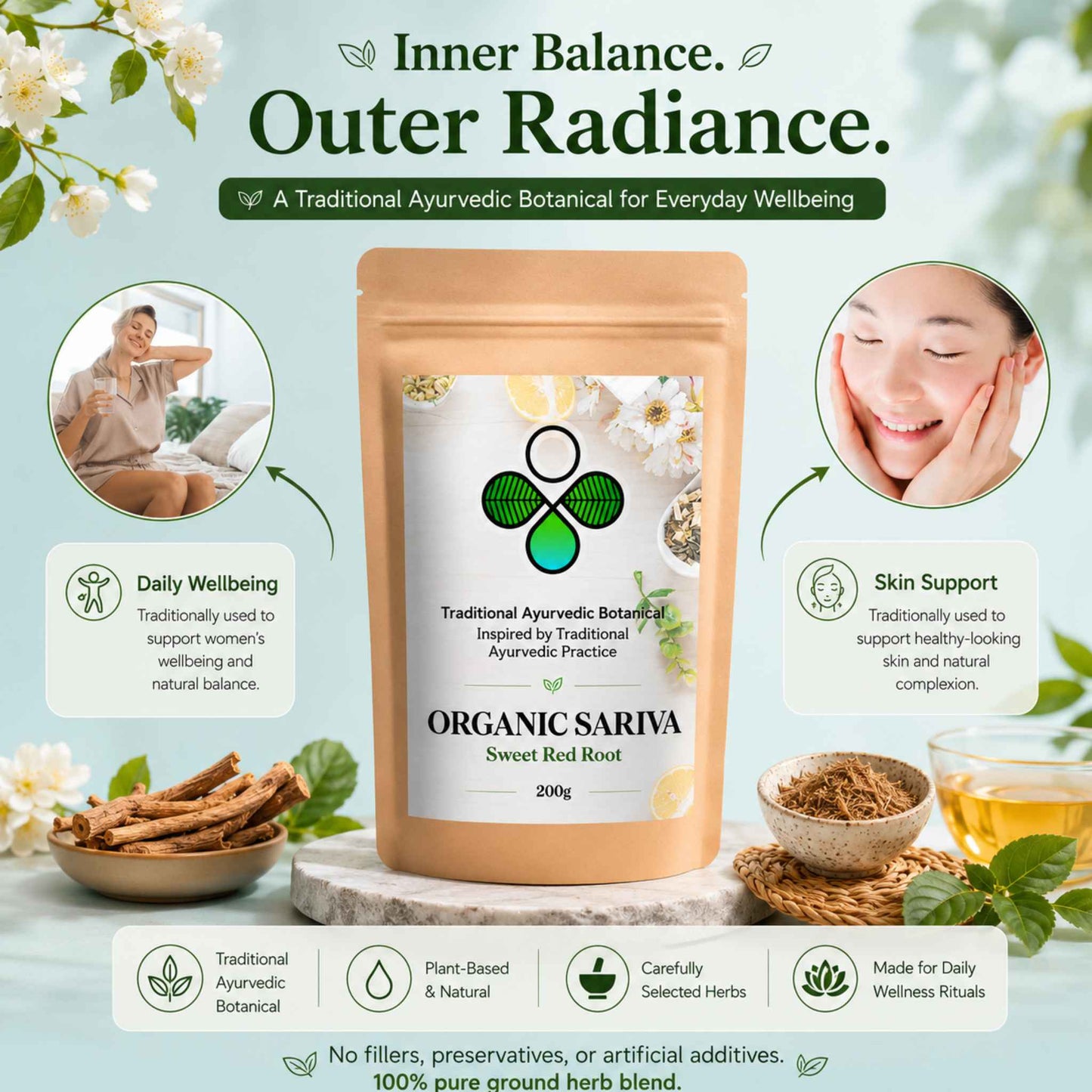
Organic Indian Sarsaparilla (Sariva) – Ayurvedic Cooling Herb for Skin Radiance & Natural Glow

Organic Indian Sarsaparilla (Sariva) – Ayurvedic Cooling Herb for Skin Radiance & Natural Glow

Regular price $10.00
Regular price Sale price $10.00
Sale Sold out
Size
View full details

About This Herb

Sariva (Hemidesmus indicus), also known as Indian Sarsaparilla, Anantamula ("the endless root"), or Nannari, is one of Ayurveda's most graceful and deeply cherished sweet roots. Its very name Sariva evokes its essence: a cooling, fragrant, blood-cleansing herb that moves gently and persistently through the body's fluid channels, cleansing without depleting, cooling without drying, and building while it clears.

In Ayurvedic tradition, Sariva is a pre-eminent Rakta shodhana (blood-purifying) and Pittasamshamana (Pitta-pacifying) herb, cooling excess heat from the blood and lymph, restoring natural fluid harmony, and allowing that inner clarity to express itself as radiant, clear skin. Unlike more aggressive cleansing herbs, Sariva combines a deep purifying action with a genuinely nourishing, building quality, making it one of Ayurveda's rare herbs that cleanses and replenishes simultaneously. This dual "cleansing and building" character is what places it firmly in the Rasayana category: a rejuvenating tonic that supports the body's long-term vitality as it clears.

In South India, Sariva (known as Nannari) has been celebrated for centuries as a summer cooling beverage, brewed as a fragrant, naturally sweet tea or syrup to cool the body, support comfortable urinary ease, and promote a light, clear feeling throughout the season. This beautifully aromatic root carries the natural fragrance of vanilla and earth, one of the most pleasant herbs in the Ayurvedic tradition to drink.

Known in botanical science as Hemidesmus indicus, its roots contain a remarkable concentration of coumarinolignoids (most notably hemidesmin I and II), flavonoids, saponins, tannins, terpenoids, and essential aromatic compounds, each contributing to its distinctive cooling, blood-cleansing, skin-supporting, and fluid-harmonising action. Modern botanical research has explored many of its traditional Ayurvedic applications, with naturally soothing, naturally purifying, and traditionally nourishing properties identified across multiple botanical research studies.

Sariva is also part of Kimmana Nichols' custom-designed formula, Blemish clearing mask, a classical Ayurvedic herbal clay mask in which Sariva contributes its skin nourishing properties along with other Ayurvedic herbs. Explore Blemish clearing mask

Benefits

• Supports natural blood cleansing and the body's healthy elimination of Ama (metabolic residue), a premier Ayurvedic Rakta shodhana (blood-purifying) herb

• Cools excess Pitta, supporting a comfortable, settled internal environment with a naturally cool and balanced quality throughout the blood and tissues

• Supports clear, radiant, and naturally luminous skin from the inside out, traditionally Ayurveda's go-to herb for skin clarity that begins with inner fluid cleansing

• Supports the lymphatic channels' natural daily cleansing, traditionally used to promote comfortable lymphatic flow and a light, clear feeling in the tissues

• Supports natural fluid harmony, gently encourages the natural clearing of excess water from the tissues as part of a traditional Ayurvedic daily wellness routine

• Supports comfortable urinary ease and natural urinary wellness through its cooling and gently fluid-supporting action

• Simultaneously cleanses and nourishes, a rare Ayurvedic herb that purifies the blood and fluids while building and replenishing deep tissue vitality

• Supports natural cycle ease and comfortable monthly wellness in women, traditionally used in Ayurveda to support healthy Rakta dhatu (blood tissue) and natural female reproductive ease

• Traditionally valued for natural digestive ease, used across Ayurveda, Siddha, and Unani medicine as a naturally nourishing digestive tonic

• Supports natural Ojas vitality through its blood and lymph cleansing action, a clean, well-supported system naturally supports the body's own Ojas and natural seasonal resilience

• Rich in naturally occurring antioxidants, supporting healthy cellular function, natural skin vitality, and whole-body wellness

• A naturally fragrant, pleasant-tasting herb, traditionally enjoyed as a cooling tea or syrup in South Indian wellness tradition

Directions for Use

Standard dose: 1–8 grams per day, best infused or decocted as a tea, or as directed by your Ayurvedic practitioner.

As a decoction (traditional and most effective preparation): Simmer 1–2 teaspoons of Sariva root powder in 2–3 cups of water for 10–15 minutes. Strain well and sip warm or at room temperature. Decocting fully extracts the herb's water-soluble coumarinolignoid and flavonoid compounds for a full-expression traditional preparation.

As a cool infusion (traditional Nannari method): Steep 1–2 teaspoons in 2 cups of cool or room temperature water for 20–30 minutes. Strain and sip. This traditional South Indian preparation is particularly pleasant as a cooling daily drink in warm weather, naturally sweet with a delicate vanilla-earth aroma.

With cool water or milk: For a simple daily preparation, stir ¼–½ teaspoon into cool water or cool dairy or plant-based milk. Taking with cool liquid enhances the herb's Pitta-pacifying and cooling action.

With honey: Mix with a small amount of raw honey for a traditional skin and blood wellness preparation. 

With ghee or warm milk (for Vata types): If you have a naturally dry or Vata-dominant constitution, take Sariva with a small amount of warm ghee or warm milk to support comfortable absorption and offset any cooling tendency.

Seasonal use: Particularly valued in Ayurvedic tradition during summer and the spring-summer seasonal transition as a daily cooling, blood-cleansing, and skin-supporting tonic. Consistent use over 4–8 weeks supports deep tissue cleansing and naturally radiant skin.

Note: Please consult your healthcare practitioner before use if you are pregnant, breastfeeding, or taking medications. Due to its cooling and heavy nature, those with a strongly Kapha-dominant constitution or sluggish digestion are advised to begin with a smaller dose and seek practitioner guidance.

Key Botanicals

Sariva root powder (Hemidesmus indicus), certified organic, whole dried root, ground

No fillers, binders, preservatives, or additives. 100% pure certified organic Sariva (Indian Sarsaparilla) root powder.

  • benefits of 2-hydroxy-4-methoxybenzaldehyde in sariva
  • benefits of isoquercetin, rutin, and hyperoside in sariva
  • benefits of saponins in sariva
  • benefits of lupeol acetate in sariva

Frequently Asked Questions

What is Sariva and what makes it unique in Ayurveda? +

Sariva (Hemidesmus indicus / Indian Sarsaparilla / Anantamula / Nannari) is one of Ayurveda's most graceful and cooling sweet roots, classified as both a Rakta shodhana (blood-cleansing) and a Rasayana (rejuvenating tonic). What makes Sariva unique is its dual action: it simultaneously cleanses and nourishes, purifying the blood and lymph while building and replenishing the tissues. Known as Nannari in South India, it is traditionally enjoyed as a cooling summer beverage for its naturally sweet, vanilla-like fragrance and flavour. It is not a treatment for any medical condition.

How do I take Sariva root powder? +

Sariva is most effectively prepared as a decoction, simmer 1–2 teaspoons in 2 cups of water for 10–15 minutes, strain, and drink warm or at room temperature. It can also be prepared as a cool infusion by steeping in room temperature water for 20–30 minutes, the traditional Nannari method. A pleasant daily tea with a naturally sweet, floral aroma. Can also be mixed with warm milk or honey. Consult your healthcare practitioner before beginning use.

Can Sariva help with skin rashes or heat-related skin conditions? +

Sariva is one of Ayurveda's most traditionally valued herbs for skin concerns associated with Pitta excess, its cooling, blood-cleansing action addresses the internal heat that manifests as skin warmth, redness, and discomfort. It is used in classical Ayurvedic formulas for skin wellness alongside Neem, Manjistha, and Guduchi. Sariva is not a treatment for any skin condition, rash, or skin disease. Consult a dermatologist for persistent skin concerns.

Can Sariva support urinary ease and natural fluid balance? +

Sariva is traditionally classified as a Mutrala (naturally fluid-supporting) herb in Ayurveda, valued for supporting comfortable urinary ease, natural fluid balance, and the cool, light feeling associated with well-supported urinary channels. It is particularly valued in summer as a cooling, fluid-supporting daily tonic. Sariva is not a treatment for any urinary condition. Please consult your healthcare practitioner for urinary health concerns.

What is the difference between Sariva and Manjistha for skin wellness? +

Both are classical Ayurvedic Rakta shodhana herbs for naturally clear skin but with different characters. Sariva (Indian Sarsaparilla) is sweeter, more cooling, and more fluid-supporting, better for Pitta-Vata skin types with dryness and heat. Manjistha (Indian Madder) is stronger and more specifically targeting congestion in the blood and lymph, better for Pitta-Kapha skin with active heat and tissue congestion. Many classical Ayurvedic skin formulas combine both.